
Skylight Cleaning in Bucks County, PA
Skylights are the most neglected glass in almost every house we visit, and the reason is simple: they are hard to get to. They sit overhead, often over a stairwell or a vaulted great room, and reaching them safely takes equipment and a plan rather than a step stool. So they get left, sometimes for a decade, while the homeowner slowly forgets the room used to be brighter.
They are also the glass that collects the most. A vertical window sheds rain, a skylight faces straight up and catches everything that falls: leaf litter, pine needles, seed pods, roof grit, pollen, bird droppings, and the mineral residue left behind every time standing water evaporates off it. On top of that, the interior face collects the warm, greasy air that rises through a house, which is why the inside often turns out to be hazier than the outside.
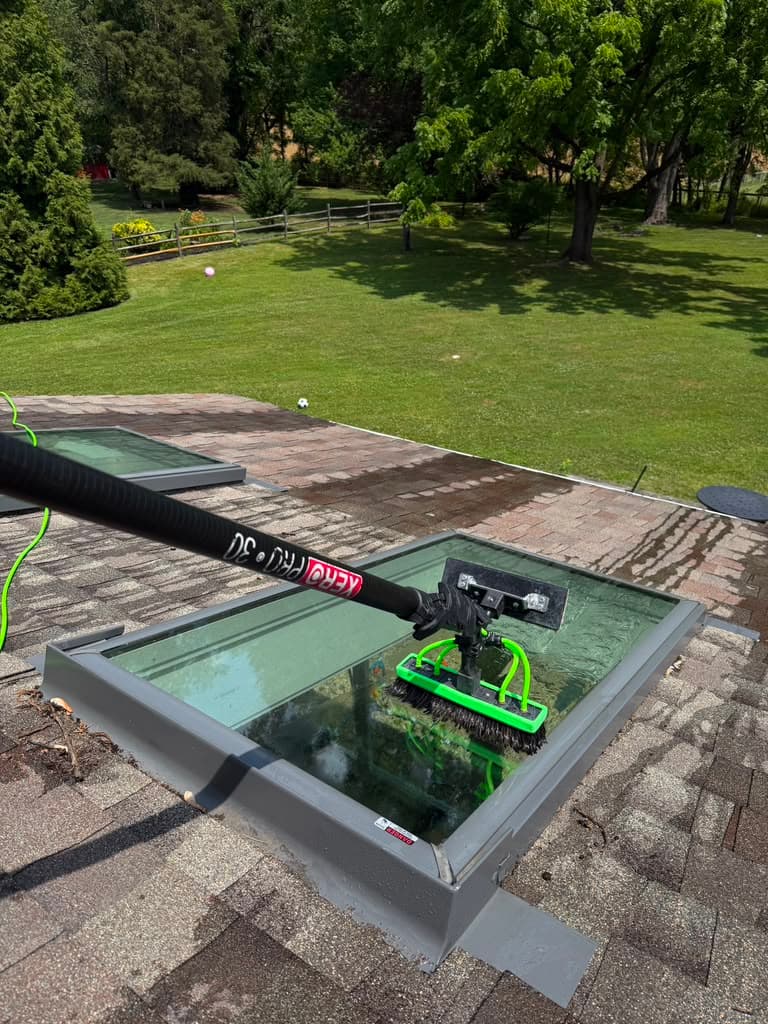
The water fed pole changes how this job gets done. Most skylights are reached from the roof edge or from the ground, which keeps us off the pitch entirely. Some genuinely cannot be, and for those we do go up, carefully and properly equipped, rather than pretending the job can always be done from below. The deionized water matters more here than anywhere else on the house: a skylight is the one pane you cannot easily go back and buff dry, so water that dries perfectly clear on its own is exactly what it needs.
What's included in a skylight clean
Exterior glass washed and rinsed pure
Scrubbed and rinsed with deionized water, including the mineral staining that builds up where water pools and evaporates at the low edge.
Interior glass cleaned
The inside face is washed and detailed from below. This is usually where the biggest visible difference comes from.
Frames and curbs cleaned
The frame and the raised curb the skylight sits on get cleaned, including the channel where debris packs in.
Skylight wells cleaned
The angled shaft between the ceiling and the glass collects dust and cobwebs and is very visible once the glass is clear. It gets cleaned as part of the job.
Debris cleared from around the unit
Leaf litter and needles sitting against the flashing come off. Left there they hold moisture against the seal.
A condition report on seals and flashing
We are up close anyway. If we see failing seal, cracked flashing sealant, or a fogged unit, we tell you. Cleaning does not fix any of them.
Our process, start to finish
Exactly how the job runs when we turn up.
We assess access and roof pitch first
Before quoting we look at how the skylight can be reached safely: roof pitch, surface type, ceiling height inside, and what is underneath. If a unit cannot be reached safely, we say so rather than improvising.
The room below is protected
Drop cloths go down under the skylight and furniture is moved clear before any interior work starts.
Loose debris is cleared dry
Leaves, needles, and grit come off the glass and out of the curb channel dry, before anything is wet. Otherwise it just turns to slurry and streaks.
Exterior glass is scrubbed with the pole
The brush head works the pane from the roof edge or the ground. Mineral staining at the low edge gets treated separately where it has built up.
Rinsed with deionized water
The pure water rinse is what lets an overhead pane dry clear without anyone having to reach back up to buff it.
Frames, curb, and flashing line are cleaned
Cleaned along with the glass so the whole unit looks finished rather than just the pane.
Interior glass and well are cleaned from below
Washed and detailed with extension equipment, working carefully so nothing drips onto the room below.
We show you the result and report what we found
Including anything we noticed about seals, flashing, or a fogged unit that you will want to know about.
What affects the price
No dollar figures here, every property is different. These are the honest factors that move a quote up or down, so you know what we're looking at when we walk your property.
How many skylights
The main driver. Setup is the expensive part, so several units in one visit costs far less per skylight than one on its own.
Roof pitch and access
A low pitch, easily reached roof is straightforward. A steep pitch, a slate or metal surface, or a unit only reachable over a lower roof takes significantly more setup.
Interior ceiling height
A skylight over a two storey vaulted great room needs extension equipment that a standard height hallway does not.
Mineral staining
Because skylights face up, water sits on them and evaporates in place. Years of that leaves deposits that need separate treatment.
Debris load
A skylight under mature trees can have years of packed needles and leaf mould in the curb channel.
How long since the last cleaning
Skylights that have never been cleaned are genuinely a bigger job than ones done a couple of years ago. This is the service where that gap matters most.
How often should skylights be cleaned?
Once a year is right for most homes, and autumn is the best time, after the leaves are down, so you clear the season's debris off the glass and out of the curb before winter rather than leaving it to sit wet against the seal for months.
Twice a year is worth it if the skylight sits directly under mature trees, especially pines. Needles pack into the curb channel, hold water against the flashing, and are the most common reason a skylight that is otherwise fine starts to leak.
Because skylights are awkward to reach, most people leave them far longer than that. Five or ten years is common, and we clean plenty that have never been touched. A neglected skylight is not just a brightness issue: debris held against the seal and flashing is what turns an aging unit into a leaking one.
Skylight Cleaning questions
- Can you clean skylights on a steep or high roof?
- In most cases, yes. The water fed pole reaches overhead glass from the roof edge or from the ground, which means far less time spent walking a pitched roof than traditional methods require. What we will not do is take a risk on a roof surface or pitch that cannot be worked safely. If that is the situation we will tell you honestly and stop, rather than attempt it and damage the roof or ourselves.
- My skylight looks foggy between the panes. Will cleaning fix it?
- No, and this is worth understanding before you book. Haze trapped between the two panes of a sealed unit means the seal has failed and moisture has got inside the glass sandwich. That is physically inside the unit, so no amount of cleaning either surface will touch it. The fix is replacing the unit. We will always identify this and tell you before doing the work rather than cleaning it and letting you discover it afterwards.
- Do you clean the inside of the skylight too?
- Yes, both faces plus the well. The interior surface is usually the hazier of the two, because warm greasy air rises and settles on it, so for most rooms the inside is where the visible difference actually comes from. The angled well between the ceiling and the glass is cleaned as part of the same visit.
- Will you notice if my skylight has a problem?
- We will tell you what we see. We are not roofers and we do not inspect or certify anything, but we are up close to units that most people never get near, so we regularly spot failing seals, cracked sealant at the flashing, and debris packed against the curb. You will get an honest report of what we noticed so you can get the right trade in if it needs one.
More questions? See the full FAQ page.
Our other window cleaning services
Exterior Window Cleaning
Glass, frames, and sills washed with purified water from the ground.
Exterior Cleaning in Bucks CountyInterior Window Cleaning
Streak-free glass inside, with your floors and furniture protected.
Interior Cleaning in Bucks CountyScreen Cleaning
Removed, washed, dried, and reinstalled square and secure.
Screen Cleaning in Bucks County
Where we work
We provide skylight cleaning across all of Bucks County, Pennsylvania.
Book skylight cleaning in Bucks County
Free quotes, clear pricing, and a satisfaction guarantee on every job.
Licensed & Insured LLC · 100% Satisfaction Guarantee